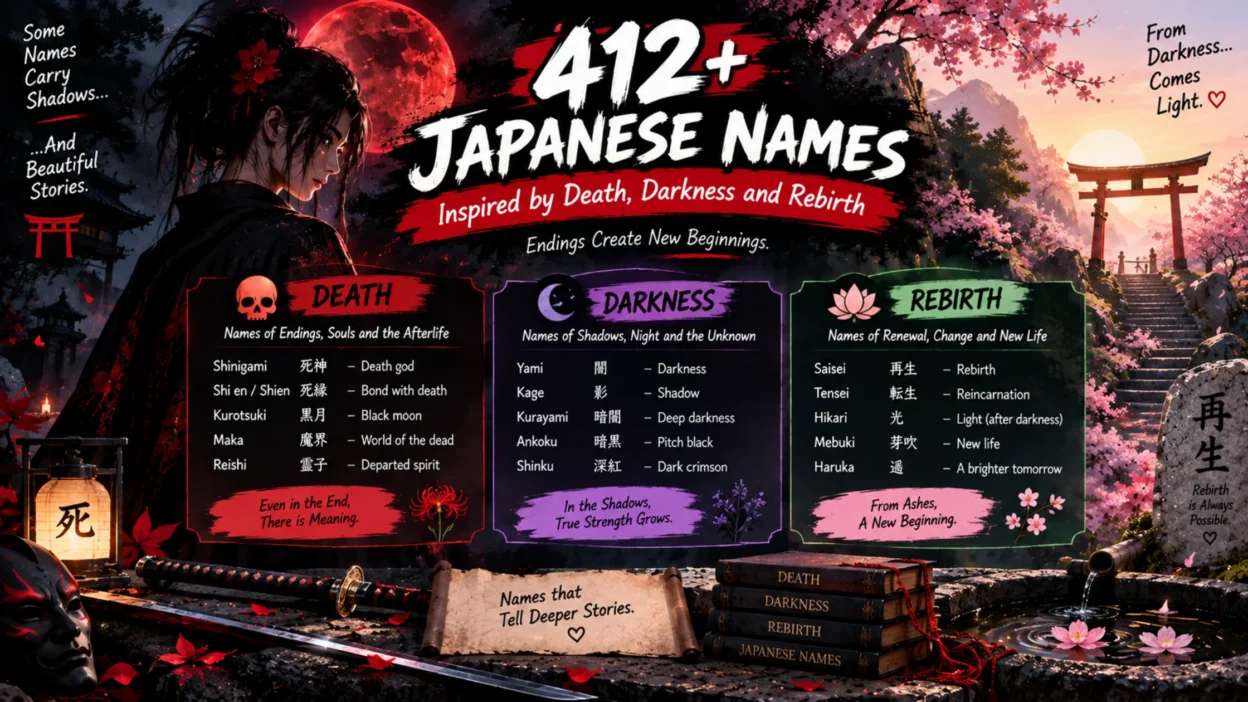
Names can carry a powerful mood. Some feel bright and cheerful, while others suggest mystery, endings, transformation, or a fresh beginning. If you are creating a character with a deeper story, Japanese Names Inspired by Death Darkness and Rebirth can provide a striking starting point.
Japanese language and culture offer many words connected with night, shadows, autumn, endings, renewal, nature, and change. However, it is important to remember that a Japanese word with a dark meaning is not automatically a traditional Japanese given name.
For fictional characters, you have much more creative freedom. You can draw from Japanese vocabulary, mythology, nature, seasons, and symbolic ideas to create a name that feels atmospheric.
This collection includes 412+ Japanese names and naming ideas inspired by death, darkness, rebirth, night, shadows, winter, ashes, transformation, and new beginnings. Some are established Japanese names, while others are words or creative combinations that work especially well for fiction.
Best Japanese Names Inspired by Death, Darkness and Rebirth
These names have a mysterious, symbolic, or transformative feeling.
- Yoru
- Kage
- Rei
- Ren
- Rin
- Yami
- Kuro
- Tsuki
- Yuki
- Shion
- Setsuna
- Homura
- Akira
- Aoi
- Sora
- Nagi
- Kasumi
- Kiri
- Fuyu
- Arashi
- Raiden
- Hotaru
- Mizuki
- Kaname
- Itsuki
- Subaru
- Hikaru
- Kohaku
- Akane
- Asahi
- Yoake
- Meguru
- Kaede
- Shizuka
- Haru
- Minato
- Tsubasa
- Hikari
- Sakura
- Kaito
For another collection with a mysterious animal theme, you can also explore our crow names.
Japanese Names Inspired by Death
Death is a sensitive and complex theme. In fiction, it can represent an ending, a major change, or the closing of one chapter.
For Japanese naming, it is usually better to use symbolic ideas such as dusk, autumn, silence, fading flowers, or impermanence rather than simply translating “death” into a personal name.
Dark and Symbolic Choices
- Shi
- Shizuka
- Setsuna
- Yoru
- Kage
- Kuro
- Yami
- Kiri
- Kasumi
- Fuyu
- Shigure
- Yoake
- Tasogare
- Maboroshi
- Kurenai
- Hotaru
- Tsukiyo
- Shion
- Rei
- Nagi
- Kuroha
- Yoruha
- Kageyuki
- Kurotsuki
- Yamikage
Some entries above are Japanese words or creative constructions rather than standard given names. They are therefore better suited to fictional characters.
Japanese Names Inspired by Darkness
Darkness does not always mean something negative. In storytelling, it can represent mystery, privacy, the unknown, or a hidden side of a character.
The Japanese word yami (闇) refers to darkness, while kage (影) means shadow.
- Yami
- Kage
- Yoru
- Kuro
- Kuroha
- Kageki
- Kagemaru
- Kageyuki
- Kagehiro
- Kagehiko
- Kageya
- Kuroki
- Kuroya
- Kuroto
- Kuroha
- Yoruha
- Yorukage
- Kurokage
- Yamikage
- Kurotsuki
- Tsukikage
- Kagezora
- Kageyume
- Kuroyuki
- Yorumori
These combinations can work beautifully in fantasy stories, games, manga-inspired projects, and supernatural settings.
Japanese Names Inspired by Night
Night is one of the strongest themes for a dark but elegant name.
Yoru (夜) means “night.”
- Yoru
- Yoruko
- Yoruha
- Yoruya
- Yoruaki
- Yoruhiro
- Yorumi
- Yorina
- Yoruto
- Yorukage
- Yorutsuki
- Yorusora
- Yoruame
- Yoruyuki
- Yoruhana
- Yorumori
- Yoruoto
- Yoruhoshi
- Yoruyume
- Yoruishi
For fiction, these combinations can create a strong nighttime atmosphere.
Japanese Names Inspired by Shadows
Shadows suggest secrecy, memory, and hidden identity.
The Japanese word kage (影) means “shadow.”
- Kage
- Kageya
- Kageo
- Kageki
- Kagemaru
- Kagehiro
- Kagehiko
- Kageyuki
- Kageaki
- Kageharu
- Kagefumi
- Kagehito
- Kagezora
- Kageyume
- Kagehana
- Kageame
- Kageoto
- Kageishi
- Kagekiri
- Kagemori
Japanese Names Inspired by the Moon
The moon can symbolize darkness, cycles, change, and renewal.
Tsuki (月) means “moon.”
- Tsuki
- Tsukiko
- Tsukiyo
- Tsukina
- Tsukino
- Tsukimi
- Tsukika
- Tsukine
- Tsukiharu
- Tsukiyuki
- Tsukikage
- Tsukisora
- Tsukihoshi
- Tsukihane
- Tsukihana
- Tsukimori
- Tsukiyume
- Tsukisaki
- Tsukiyori
- Tsukifuyu
Japanese Names Inspired by Rebirth
Rebirth gives the article a brighter side. It represents returning, changing, growing, and starting again.
Useful Japanese words and concepts include atarashii for “new” and meguru, which can relate to going around or cycling depending on context.
- Meguru
- Arata
- Atarashi
- Haru
- Asahi
- Hikari
- Akira
- Nozomi
- Mirai
- Saki
- Sakura
- Hinata
- Kaede
- Aoi
- Yuzuki
- Koharu
- Haruki
- Haruto
- Asahi
- Akane
- Tomoru
- Hikaru
- Minori
- Chihiro
- Natsuki
These choices can work well for characters who survive a major event and begin a new chapter.
Japanese Names Inspired by New Beginnings
A new beginning can be represented by sunrise, spring, flowers, light, or the return of warmth.
- Haru
- Haruka
- Haruki
- Haruto
- Asahi
- Hikari
- Akira
- Hinata
- Sakura
- Saki
- Minori
- Nozomi
- Mirai
- Aoi
- Koharu
- Kaede
- Natsuki
- Tsubasa
- Tomoru
- Meguru
For a softer character concept, names associated with spring and sunlight can create a nice contrast with darker themes.
Japanese Names Inspired by Sunrise
Sunrise is a natural symbol of rebirth. After darkness comes light.
Asahi (朝日) means “morning sun” or “morning sunlight.”
- Asahi
- Yoake
- Akatsuki
- Hikari
- Hikaru
- Hinata
- Haru
- Akira
- Taiyo
- Hinode
- Koharu
- Haruki
- Haruto
- Tomoru
- Sora
- Aoi
- Natsu
- Minori
- Saki
- Mirai
These names are particularly suitable for characters who move from a difficult past toward a new future.
Japanese Names Inspired by Sunset and Dusk
Sunset can symbolize an ending while also suggesting the beginning of night.
- Tasogare
- Yuu
- Yuhi
- Yoru
- Akane
- Kurenai
- Shigure
- Kasumi
- Kiri
- Hoshi
- Tsuki
- Sora
- Yuki
- Rei
- Nagi
- Shion
- Setsuna
- Kage
- Yoake
- Hotaru
Tasogare refers to twilight or dusk and has a particularly poetic feeling.
Japanese Names Inspired by Autumn
Autumn can symbolize change, aging, endings, and the beauty of impermanence.
- Aki
- Akira
- Akiko
- Akane
- Kaede
- Momiji
- Shigure
- Koharu
- Kureha
- Kurenai
- Hotaru
- Tsukiko
- Yuzuki
- Fuyu
- Akinori
- Akihiko
- Akito
- Akiha
- Akiyuki
- Akiharu
The changing leaves of autumn can also represent a character leaving their old identity behind.
Japanese Names Inspired by Winter
Winter creates a quiet, cold, and mysterious mood.
- Fuyu
- Fuyuki
- Fuyuka
- Fuyumi
- Fuyuno
- Fuyuko
- Fuyuto
- Fuyuharu
- Fuyutsuki
- Fuyukage
- Fuyusora
- Fuyuhana
- Fuyumori
- Fuyushiro
- Fuyune
- Yukiko
- Yukina
- Yukino
- Yukihiro
- Yukiya
Winter works particularly well for characters who have a quiet or distant personality.
Japanese Names Inspired by Snow
Snow can symbolize silence, purity, coldness, or a blank page.
The Japanese word yuki (雪) means “snow.”
- Yuki
- Yukiko
- Yukina
- Yukino
- Yukihiro
- Yukio
- Yukiya
- Yukiharu
- Yukitsuki
- Yukikage
- Yukisora
- Yukihane
- Yukimori
- Yukishiro
- Yukifuyu
- Yukihoshi
- Yukinagi
- Yukine
- Yukiyume
- Yukisaki
Japanese Names Inspired by Rain
Rain can suggest sadness, cleansing, renewal, or emotional change.
Ame (雨) means “rain.”
- Ame
- Ameko
- Ameha
- Ameya
- Ameo
- Ameyuki
- Amekage
- Amehiro
- Amezora
- Amehana
- Ameishi
- Ametsuki
- Amemori
- Ameshio
- Ameyoru
- Amefuyu
- Ameoto
- Ameumi
- Ameshigure
- Ameharu
Rain is especially useful when you want a character who has endured hardship but is moving toward renewal.
Japanese Names Inspired by Mist
Mist creates an uncertain and mysterious atmosphere.
Kiri (霧) means “mist” or “fog.”
- Kiri
- Kiriko
- Kirika
- Kirito
- Kiriyuki
- Kirikage
- Kirisora
- Kiritsuki
- Kirihana
- Kirimori
- Kiriharu
- Kiriyo
- Kiria
- Kirime
- Kirine
- Kiriyume
- Kirisame
- Kirinagi
- Kirihoshi
- Kirikawa
Japanese Names Inspired by Fire and Ash
Fire can represent destruction, while its aftermath can symbolize rebuilding.
Homura (炎) refers to a flame or blaze.
- Homura
- Hibana
- Kagaribi
- Kasai
- Hi
- Enka
- Homuragi
- Homurakage
- Homuratsuki
- Homurayuki
- Homurasora
- Homurahana
- Homuraame
- Homurayume
- Homurashio
- Akane
- Akatsuki
- Kurenai
- Tomoru
- Hikari
For fictional characters, fire-themed names can represent a transformation after a difficult past.
Japanese Names Inspired by Light After Darkness
Light is one of the strongest symbols of hope.
- Hikari
- Hikaru
- Akira
- Asahi
- Hinata
- Akatsuki
- Yoake
- Tomoru
- Haru
- Haruki
- Haruto
- Sora
- Aoi
- Mirai
- Nozomi
- Saki
- Minori
- Koharu
- Natsuki
- Sakura
These names are ideal for characters whose stories move from darkness toward hope.
Japanese Names Inspired by Transformation
Transformation is the bridge between darkness and rebirth.
- Meguru
- Kaoru
- Arata
- Haru
- Kaede
- Sakura
- Aoi
- Hikari
- Akira
- Nagi
- Ren
- Rei
- Setsuna
- Chihiro
- Tsubasa
- Mirai
- Minori
- Nozomi
- Saki
- Yuzuki
Japanese Names Inspired by Silence
Silence can suggest grief, mystery, peace, or emotional distance.
- Shizuka
- Shizuku
- Rei
- Rin
- Nagi
- Yoru
- Kage
- Kasumi
- Kiri
- Fuyu
- Yuki
- Sora
- Tsuki
- Hotaru
- Shion
- Setsuna
- Mizuki
- Aoi
- Nao
- Kaname
Japanese Names Inspired by Memory
A character connected to death or rebirth may carry memories from an earlier life.
- Kioku
- Omoi
- Kokoro
- Yume
- Fumi
- Rei
- Natsume
- Chihiro
- Kaname
- Shion
- Hotaru
- Kasumi
- Mizuki
- Nozomi
- Fuyumi
- Haruka
- Sora
- Yuki
- Aoi
- Tomoe
Some of these are Japanese words or established names rather than direct translations of “memory.”
Japanese Names Inspired by Spirits and Folklore
Japanese folklore provides many ideas for fictional characters. However, cultural terms should be used thoughtfully.
- Yurei
- Yuki-onna
- Kitsune
- Tanuki
- Tengu
- Nekomata
- Kappa
- Oni
- Kodama
- Rokurokubi
- Bakeneko
- Jorogumo
- Nurarihyon
- Kudan
- Tsukumogami
- Nure-onna
- Umibozu
- Kasha
- Gashadokuro
- Hannya
These are mainly folklore terms or supernatural beings rather than ordinary personal names. They work well as inspiration for fictional characters.
Japanese Names Inspired by Mythology
Japanese mythology offers symbolic figures associated with creation, destruction, the natural world, and the cycle of life.
- Izanagi
- Izanami
- Amaterasu
- Susanoo
- Tsukuyomi
- Inari
- Hachiman
- Raijin
- Fujin
- Benzaiten
- Hō-ō
- Ryūjin
- Konohanasakuya
- Izanami
- Ame-no-Uzume
- Okuninushi
- Sarutahiko
- Ninigi
- Ōkuninushi
- Tamayori
For character creation, mythology can provide a strong symbolic foundation. Still, it is worth researching each figure before using the name in a serious project.
Dark Japanese Names for Female Characters
These names can suit female characters with mysterious, quiet, elegant, or transformative personalities.
- Rei
- Rin
- Yuki
- Yoru
- Mizuki
- Kasumi
- Shizuka
- Hotaru
- Ayame
- Tomoe
- Shion
- Setsuna
- Kuroha
- Koyuki
- Tsukiko
- Fuyuka
- Akane
- Kureha
- Sumire
- Ruri
- Yuzuki
- Satsuki
- Natsume
- Chihiro
- Nozomi
- Koharu
- Aoi
- Sakura
- Kaede
- Sayuri
Dark Japanese Names for Male Characters
These names can suit male characters with a quiet, mysterious, or dramatic identity.
- Ren
- Rei
- Riku
- Kaito
- Akira
- Akio
- Ryo
- Kai
- Itsuki
- Shion
- Raiden
- Arashi
- Kuro
- Yoru
- Haru
- Toshiro
- Hiroto
- Takumi
- Shin
- Hayate
- Kenji
- Daiki
- Ryota
- Naoki
- Yuto
- Arata
- Subaru
- Kaname
- Takeru
- Renji
Gender-Neutral Japanese Names With a Dark Mood
Gender-neutral names can be useful when the character’s identity is intentionally open.
- Rei
- Rin
- Ren
- Aoi
- Sora
- Haru
- Yuki
- Kai
- Nao
- Itsuki
- Shion
- Mizuki
- Hikaru
- Kaoru
- Akira
- Subaru
- Tsubasa
- Makoto
- Nozomi
- Izumi
- Chihiro
- Hinata
- Kaname
- Kohaku
- Ritsu
- Yuzuki
- Asuka
- Minato
- Rio
- Jun
Short Japanese Names Inspired by Darkness
Short names work well for usernames and fictional characters.
- Rei
- Ren
- Rin
- Ryo
- Kai
- Kage
- Kuro
- Yoru
- Yami
- Yuki
- Aoi
- Sora
- Nagi
- Riku
- Shin
- Aki
- Fuyu
- Tsuki
- Umi
- Kiri
- Nao
- Jun
- Zen
- Rio
- Sol
Elegant Japanese Names With a Dark Feeling
Dark does not always mean harsh. Elegant names can create a softer sense of mystery.
- Kasumi
- Shizuka
- Mizuki
- Hotaru
- Yuki
- Aoi
- Rei
- Rin
- Sayuri
- Sumire
- Tomoe
- Shion
- Ruri
- Kaoru
- Koharu
- Yuzuki
- Nozomi
- Chihiro
- Tsukiko
- Fuyuka
- Ayame
- Sakura
- Kaede
- Akane
- Hikari
Powerful Japanese Names Inspired by Rebirth
These names can fit characters who overcome darkness and return stronger.
- Arata
- Akira
- Haruki
- Haruto
- Asahi
- Hikari
- Hikaru
- Raiden
- Homura
- Takeru
- Kaito
- Ren
- Riku
- Subaru
- Akatsuki
- Tomoru
- Meguru
- Mirai
- Nozomi
- Minori
Japanese Names Inspired by Cycles
Death and rebirth can be viewed as part of a cycle. Nature provides many examples of change and return.
- Meguru
- Haru
- Aki
- Fuyu
- Natsu
- Tsuki
- Hoshi
- Sakura
- Kaede
- Yuki
- Asahi
- Yoake
- Tasogare
- Kage
- Yoru
- Ame
- Nagi
- Sora
- Umi
- Mori
Dark Japanese Names for Anime Characters
If you are creating an anime-style character, short and memorable names often work well.
- Rei
- Ren
- Rin
- Akira
- Kaito
- Shion
- Riku
- Yuki
- Aoi
- Sora
- Kuro
- Yoru
- Kage
- Setsuna
- Homura
- Raiden
- Arashi
- Kaname
- Itsuki
- Mizuki
- Nagi
- Fuyuki
- Kuroha
- Tsukiko
- Kasumi
For more character naming ideas, you can also browse our skeleton names.
Dark Japanese Names for Fantasy Characters
Fantasy settings give you more freedom to combine symbolic Japanese words.
- Kageyuki
- Tsukikage
- Yoruha
- Kurotsuki
- Amekage
- Fuyukage
- Hoshikage
- Kurohana
- Yorumori
- Tsukihane
- Kageyume
- Yorusora
- Kurohane
- Raikage
- Arashikage
- Fuyutsuki
- Yukikage
- Kagezora
- Homurakage
- Shigureya
- Kurotsume
- Yoruishi
- Tsukimori
- Kagemori
- YumeKage
These are creative combinations. They should not automatically be presented as traditional Japanese personal names.
Dark Japanese Names for Villains
A villain’s name can be mysterious without being overly harsh.
- Kage
- Yoru
- Kuro
- Rei
- Shion
- Setsuna
- Raiden
- Arashi
- Homura
- Kuroha
- Kagemaru
- Yamikage
- Kurotsuki
- Yoruha
- Tsukikage
- Kageyuki
- Fuyukage
- Kuroyuki
- Shigure
- Kasumi
Japanese Names for Characters Who Return From Darkness
If your character has survived a difficult past, names connected with dawn and renewal can create meaningful symbolism.
- Asahi
- Yoake
- Akatsuki
- Hikari
- Hikaru
- Haru
- Arata
- Mirai
- Nozomi
- Saki
- Minori
- Meguru
- Tomoru
- Hinata
- Sakura
- Kaede
- Aoi
- Koharu
- Haruki
- Haruto
Japanese Names Inspired by Ashes and Renewal
Ash is a strong fictional symbol. Something ends, but something new can eventually grow.
- Hai
- Homura
- Hibana
- Tomoru
- Hikari
- Akatsuki
- Asahi
- Haru
- Arata
- Kaede
- Sakura
- Meguru
- Mirai
- Minori
- Nozomi
- Saki
- Aoi
- Hinata
- Haruki
- Koharu
Here, hai is the Japanese word for ash. It is better treated as vocabulary or fictional inspiration than as a conventional given name.
Japanese Names Inspired by the Circle of Life
Nature provides a gentle way to represent death, renewal, and transformation.
- Haru
- Natsu
- Aki
- Fuyu
- Sakura
- Kaede
- Tsuki
- Yuki
- Ame
- Sora
- Umi
- Mori
- Kawa
- Hoshi
- Asahi
- Yoake
- Tasogare
- Kage
- Yoru
- Meguru
How to Choose Japanese Names Inspired by Death Darkness and Rebirth
Choosing a name becomes easier when you first decide what kind of symbolism you want.
Decide What the Darkness Represents
Darkness can mean different things.
It may represent:
- Mystery
- Grief
- Solitude
- Hidden identity
- Fear
- Change
- The unknown
- A difficult past
Choose a name based on your character’s actual story.
Choose a Symbol
A single symbol can make your naming process easier.
Try:
Night: Yoru
Shadow: Kage
Darkness: Yami
Moon: Tsuki
Snow: Yuki
Rain: Ame
Mist: Kiri
Storm: Arashi
Fire: Homura
Dawn: Yoake
Morning sun: Asahi
Then build the character around that theme.
Think About the Character Arc
A character who begins in darkness but eventually changes might suit a name connected with dawn.
On the other hand, a character who remains mysterious could suit a shadow or night theme.
This makes the name feel connected to the story.
How to Create Your Own Dark Japanese Names
For fictional characters, combining Japanese words can produce atmospheric results.
Night + Shadow
- YoruKage
- KageYoru
- Yoruha
- Kageyoru
Moon + Shadow
- Tsukikage
- Tsukiyoru
- KageTsuki
- Kurotsuki
Winter + Shadow
- Fuyukage
- Yukikage
- Fuyuyoru
- Fuyutsuki
Rain + Shadow
- Amekage
- Ameyoru
- AmeKuro
- AmeTsuki
Dawn + Rebirth
- YoakeHaru
- AsahiHaru
- AkatsukiHaru
- HikariArata
These are best treated as fictional constructions rather than automatically authentic Japanese given names.
Important Tips for Authentic Japanese Naming
If you are using Japanese Names Inspired by Death Darkness and Rebirth, cultural accuracy matters.
Check the Kanji
The same pronunciation can have multiple kanji spellings.
Each spelling can change the meaning.
Check the Reading
Do not assume that any combination of kanji will produce the reading you expect.
Separate Words From Names
A Japanese word can be beautiful and meaningful without being a common personal name.
For example, yami means darkness, but that does not make it a standard Japanese given name.
Use Fictional Names Carefully
Fantasy gives you more freedom.
You can use symbolic combinations for fictional characters, but label them as creative constructions rather than traditional names.
Consider the Character’s Setting
A historical Japanese character, modern Japanese character, and fantasy character may require very different naming approaches.
Frequently Asked Questions About Japanese Names Inspired by Death Darkness and Rebirth
1. What Japanese name means darkness?
Yami (闇) is a Japanese word meaning “darkness.” However, it is not automatically a conventional Japanese given name. For fictional characters, it can inspire darker naming concepts.
2. What Japanese name means shadow?
Kage (影) means “shadow.” It works well as a symbolic word or fictional character name, although it should not automatically be treated as a common Japanese given name.
3. What Japanese name means night?
Yoru (夜) means “night.” It creates a mysterious atmosphere and can work particularly well for fictional characters.
4. What Japanese name represents rebirth?
There is not one universal Japanese given name that directly means “rebirth.” Names and words associated with dawn, spring, renewal, light, and new beginnings can suggest the idea more naturally.
5. What Japanese names are good for a dark character?
Names such as Rei, Ren, Rin, Yoru, Kage, Shion, Kasumi, Setsuna, Kuro, and Tsuki can create a mysterious mood. For fictional characters, combinations such as Tsukikage or Kageyuki can add a stronger fantasy feeling.
6. Can I use these names for anime or fantasy characters?
Yes. Many of the words and creative combinations in this list can work well for anime-inspired characters, novels, games, comics, and fantasy worlds. Just remember that a Japanese-sounding combination is not necessarily a traditional Japanese personal name.
Final Thoughts
Japanese Names Inspired by Death Darkness and Rebirth can give fictional characters a powerful sense of identity. Instead of focusing only on the word “death,” consider the wider themes surrounding it.
Night can represent mystery. Shadows can suggest a hidden past. Winter can symbolize an ending. Rain can represent cleansing. Fire can represent destruction and transformation. Finally, dawn can represent hope and a new beginning.
Names such as Yoru, Kage, Tsuki, Kasumi, Shion, Setsuna, Asahi, Hikari, and Arata offer different sides of this theme.
For fictional worlds, creative combinations can take the idea even further. However, if you want an authentic Japanese name, always check the kanji, pronunciation, and cultural context.
You can also explore our dark Japanese names for more mysterious options, or browse our funny skeleton names if you want a lighter approach to darker themes.
For additional tradition and travel information about Japan, the official Japan National Tourism Organization is a useful resource

Muhammad Arslan is the founder of Namelixa and a passionate researcher of names and their meanings. He shares helpful baby names, pet names, and creative name ideas to help readers find the perfect name.