SEO Title: Last Names That Mean Death: Dark, Rare & Mysterious Surnames
Meta Description: Explore last names that mean death, plus surnames linked to mortality, graves, darkness, mythology, and powerful gothic symbolism.
URL Slug: last-names-that-mean-death
Focus Keyword: last names that meaning death
Some surnames carry an unmistakably dark atmosphere. They may come from words connected with death, burial, violence, darkness, mortality, or places associated with stillness and endings. Others have a less direct history but have developed strong death-related symbolism through language, folklore, or literature.
If you searched for last names that meaning death, the more natural phrase is last names that mean death. However, the search usually points to the same idea: surnames with literal, historical, symbolic, or fictional connections to mortality.
One important distinction matters here. Not every surname that sounds dark actually originated from a death-related word. Mort, for example, has a documented connection to Old French mort, meaning “death,” while Mortimer comes from the Norman place-name Mortemer and has been associated with “dead sea” or stagnant water. Coffin, despite its modern appearance, originally referred to a container or chest rather than a burial coffin.
With that distinction in mind, this guide separates historically supported surnames from names that are better understood as dark, gothic, or fictional surname ideas.
Surnames With a Direct Death Connection
Only a small number of established surnames have a genuinely direct connection to the word “death.” These are especially interesting for writers, researchers, and anyone looking for a surname with a strong literal meaning.
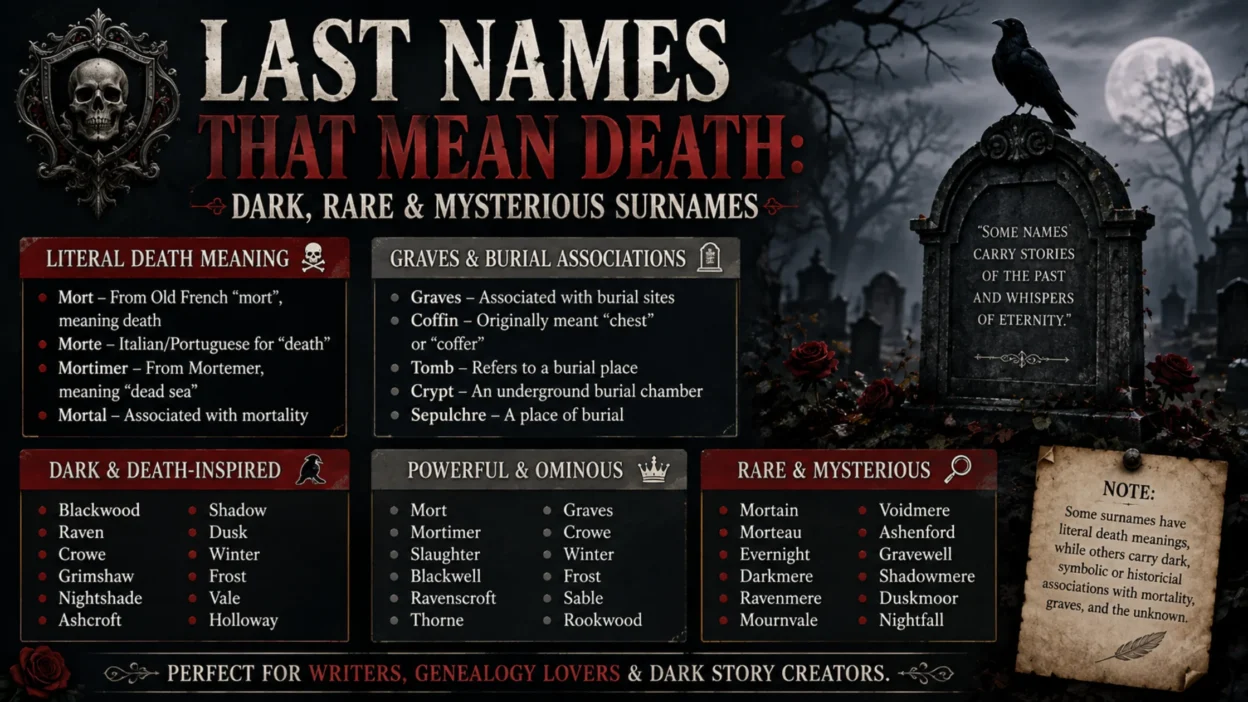
- Mort — An English and French surname connected with Old French mort, meaning “death” or “dead.”
- Morte — A real surname; FamilySearch connects it with Mort, while morte is also the Italian and Portuguese word for “death.”
- Mortimer — A Norman surname derived from Mortemer, historically interpreted in connection with “dead sea” or stagnant water.
- Morton — A genuine surname whose place-name elements do not literally mean death, but its first element can invite a darker modern interpretation.
- Mortal — A rare surname-style choice associated with mortality rather than a firmly established literal “death” etymology.
- Morton — A long-established English surname with several place-name origins; it can nevertheless work as a subtle mortality-themed surname.
- Morton-Mort — A modern compound suitable for fiction rather than a traditional surname.
- Morteau — A French place-name form that contains the mort element and can inspire a dark fictional surname.
- Mortain — A Norman place-name surname with a similar mort sound and historical connection to Mortain in France.
- Mortonvale — A creative surname-style construction based on the mort root.
For accuracy, Mort is the clearest example in this group. FamilySearch specifically records the English and French surname as deriving from Old French mort, from Latin mors or mortuus.
Last Names Associated With Graves and Burial
Some surnames do not literally translate as “death,” but their modern associations strongly connect them with burial, graves, or funerary imagery. These can be excellent choices for gothic characters.
- Graves — Strongly associated with burial, although its surname history has several possible origins.
- Grave — An English surname with possible occupational, geographic, and other roots.
- Graver — A surname that can evoke grave imagery but has its own historical origins.
- Coffin — A real English surname whose original etymology referred to a container or chest, not specifically a burial coffin.
- Coffer — Related historically to the same broader word family as Coffin and originally associated with a chest or container.
- Tomb — A surname-style option with direct burial imagery.
- Sepulchre — A rare surname-style choice based on a burial chamber.
- Crypt — A dark surname-style option referring to an underground burial chamber.
- Ossuary — A creative surname choice based on a place where bones are kept.
- Burial — A highly literal fictional surname construction.
- Graveyard — Better suited to fiction than genealogy.
- Gravestone — A dramatic surname-style creation.
- Gravewell — A gothic fictional surname.
- Gravesend — A real place-name surname with a strong grave-related appearance.
- Graveley — A real surname and place-name form that resembles “grave” without necessarily meaning a burial site.
A useful warning applies to Graves. FamilySearch gives several possible origins, including a variant of Grave, but those origins are not simply “graveyard.”
Likewise, Coffin has a surprisingly different history. FamilySearch explains that the surname comes from Old French cofin, meaning a container, basket, coffer, or chest; the modern English funerary meaning developed later.
Dark Surnames With Mortality Themes
Sometimes you want a surname that feels connected to death without literally translating as “death.” These names create that atmosphere through darkness, ravens, shadows, ashes, or other imagery.
- Blackwood — A dark forest surname with a gothic atmosphere.
- Blackwell — A real surname with a dark visual quality.
- Blackburn — A real English surname meaning a dark or black stream in its surface interpretation.
- Raven — A surname associated with the raven’s long-standing dark symbolism.
- Ravenwood — A gothic surname-style combination.
- Ravenscroft — A real surname form meaning a raven’s small field or enclosure.
- Crowe — A surname associated with the crow, a bird often used in dark symbolism.
- Crow — A straightforward bird-based surname with ominous literary associations.
- Grimshaw — A real English surname with a strongly dark-sounding modern appearance.
- Grimm — A real surname that has gained a strong association with dark fairy tales.
- Nightshade — A dark botanical surname-style option.
- Ash — A real surname with associations that can include ash and trees.
- Ashford — A genuine surname with a much more ordinary place-name origin despite its darker modern sound.
- Ashcroft — A real surname with an earthy, ash-related appearance.
- Dusk — A concise fictional surname choice associated with endings and twilight.
- Shadow — Better understood as a modern or fictional surname-style choice.
- Nocturne — A dark artistic surname-style option inspired by nighttime.
- Nightfall — A fictional surname with an ending-of-day atmosphere.
- Darkwood — A fictional surname construction with an obvious gothic tone.
- Hollow — A surname-style choice suggesting emptiness or a quiet place.
These names are best described as death-associated or dark surnames, rather than claiming that each literally means death.
Gothic Last Names
Gothic surnames can create an elegant sense of mystery without needing an explicit death meaning. They are especially useful for fantasy characters, novels, role-playing games, and gothic-inspired identities.
- Blackwood
- Ravenscroft
- Grimshaw
- Grimm
- Raven
- Crowe
- Ashcroft
- Blackwell
- Nightshade
- Darkwood
- Holloway
- Winter
- Winters
- Frost
- Thorne
- Vale
- Hawthorne
- Rookwood
- Mourning
- Sable
- Noir
- Dusk
- Hollow
- Shadow
- Evernight
For more surname inspiration outside the death theme, these fancy last names offer a broader collection of elegant and distinctive choices.
Powerful Last Names Linked to Death
If the goal is a character who should sound formidable, choose a surname that suggests mortality, conflict, darkness, or an imposing presence.
- Mort
- Mortimer
- Slaughter
- Graves
- Blackwood
- Grimshaw
- Ravenscroft
- Blackwell
- Crowe
- Raven
- Thorne
- Frost
- Winter
- Ashcroft
- Rookwood
- Vale
- Sable
- Holloway
- Stone
- Gravesend
Slaughter deserves a particularly careful explanation. It is a real English surname, but its historical origin is occupational. Ancestry describes it as coming from Middle English slaughter, meaning “butcher,” while the Oxford Dictionary of Family Names records the occupational connection to butchery.
Therefore, it is death-associated in modern interpretation, but saying that every Slaughter family literally received the surname because of death would be inaccurate.
Rare-Sounding Last Names With Dark Meanings
These choices are useful when you want a surname that feels unusual while retaining a dark atmosphere.
- Mort
- Morte
- Mortimer
- Mortain
- Morteau
- Grimshaw
- Ravenscroft
- Rookwood
- Blackwood
- Nightshade
- Ashcroft
- Dusk
- Evernight
- Shadowmere
- Gravewell
- Darkmere
- Mournvale
- Ravenmere
- Hollowmere
- Ashenford
Some of these are established surnames or place-name forms, while others are creative surname constructions. That distinction matters if you are researching genealogy rather than naming a fictional character.
Last Names Inspired by Death and Darkness
A surname does not need a literal translation to create the right atmosphere. Symbolic associations can be just as effective.
- Raven — Associated with mystery and dark folklore.
- Crowe — Evokes the crow’s traditional ominous imagery.
- Blackwood — Combines darkness with a forest setting.
- Grimshaw — Has a distinctly gothic sound.
- Winter — Suggests coldness, dormancy, and stillness.
- Frost — Gives a cold and severe impression.
- Thorne — Suggests danger and a protective barrier.
- Ash — Can evoke remains as well as the tree.
- Ember — Suggests what remains after a fire.
- Sable — A dark color with an elegant tone.
- Vale — Creates an atmospheric landscape image.
- Holloway — Suggests a hollow or secluded path.
- Rookwood — Combines a dark bird with woodland imagery.
- Nightshade — Connects darkness with a poisonous plant.
- Dusk — Represents the transition into night.
- Shadow — Suggests mystery and absence of light.
- Noir — Gives a distinctly dark artistic feel.
- Mourning — Directly evokes grief and loss.
- Grave — Connects strongly with burial imagery.
- Void — A modern fictional choice suggesting emptiness.
Last Names Inspired by Death in Different Languages
Language can provide interesting inspiration, but it is important to distinguish between a word meaning death and a surname that actually exists.
Latin-Inspired
- Mort — Connected to the Latin root mors, “death.”
- Mortis — Latin grammatical form meaning “of death”; better suited to fiction than as a traditional surname.
- Mortem — Latin accusative form of “death”; primarily a word rather than an established surname.
- Mortuus — Latin for “dead”; useful for fictional naming.
- Mors — Latin word for death and a strong fictional surname choice.
The Latin mort- root appears in many European words associated with death and mortality, which explains why it is so recognizable in surname-inspired naming.
Italian-Inspired
- Morte — Italian for “death” and also a documented surname. FamilySearch lists Morte as a surname and directs its meaning to Mort. (FamilySearch)
- Morti — A surname-style variation connected to the same linguistic family.
- Mortelli — A fictionalized surname built around the mort- root.
- Mortez — A modern surname-style construction rather than a traditional Italian surname.
French-Inspired
- Mort — French mort means “dead” or “death,” and Mort is also an established surname. (FamilySearch)
- Mortel — French-inspired and associated with mortality.
- Mortelle — A feminine French word form meaning mortal/dead depending on context; better for fiction.
- Morteau — A French place-name form with the mort element.
German-Inspired
- Tod — German for “death”; best treated as a word-inspired fictional surname unless independently verified as a family name.
- Todes — A German-derived construction associated with death.
- Toten — Connected to the German word family for the dead.
- Todt — A historical surname form that resembles Tod, although surname origins vary.
Spanish-Inspired
- Muerte — Spanish for “death”; primarily a word rather than a standard surname.
- Mortal — Connected with mortality.
- Difunto — Spanish for deceased/dead person; better as fictional inspiration.
- Sepulveda — A genuine Spanish surname, although it should not be described simply as “meaning death.”
Japanese-Inspired
Japanese surname meanings require special care because the meaning depends on the kanji used. Some surnames contain kanji associated with death, endings, mourning, or related concepts, but that does not mean the entire surname literally translates as “death.”
For example, Japanese surname databases list surnames containing the kanji 死, which carries the meaning “death/to die,” as well as kanji associated with endings, mourning, and the afterlife.
Possible research-oriented examples include:
- Fushihara — Contains a kanji associated with death in its written form.
- Shinazugawa — Contains the same death-related kanji.
- Fujiwara — Some written variants can contain the death-related character.
- Sekimuro — Uses kanji connected with loneliness and tranquility rather than directly meaning death.
These should not be presented as simple Japanese equivalents of “death.” Japanese surname meanings depend heavily on the exact written characters.
Mythology-Inspired Last Names
Mythology provides another route for creating a death-associated surname. However, many famous death figures are traditionally given names, titles, or mythological identities, not inherited family names.
For fictional characters, you can adapt these concepts into surname-style ideas.
- Thanatos — Greek personification of death.
- Hades — Greek god associated with the underworld.
- Anubis — Egyptian deity strongly associated with funerary traditions.
- Hel — Norse ruler of the realm of the dead.
- Morrigan — Irish mythological figure associated with war and fate.
- Ereshkigal — Mesopotamian goddess of the underworld.
- Yama — Figure associated with death and judgment in Hindu and Buddhist traditions.
- Azrael — Name traditionally associated with the angel of death in Islamic and Jewish traditions.
- Osiris — Egyptian god associated with death, resurrection, and the afterlife.
- Charon — Greek mythological ferryman of the dead.
These names can inspire surnames such as House of Thanatos, Hades Vale, Anubis Blackwood, or Morrigan Graves in fiction. They should not, however, be presented as ordinary historical surnames.
Dark Last Names for Fictional Characters
Fiction gives you more freedom than genealogy. If you are naming a villain, mysterious hero, supernatural character, or gothic protagonist, you can deliberately create a surname around death imagery.
- Mortgrave
- Blackmourn
- Ravenmourne
- Graveshade
- Ashenvale
- Nightgrave
- Mournwood
- Duskgrave
- Shadowmere
- Deathmoor
- Grimvale
- Ravenmourne
- Hollowgrave
- Blackthorn
- Ashmourne
- Gravehart
- Mortvale
- Darkmere
- Nightwell
- Ravenfall
- Mournshade
- Grimwood
- Voidmere
- Duskmoor
- Shadowgrave
These are creative surname-style names, not claims about historical family names. That makes them particularly useful for novels, games, fantasy worlds, role-playing characters, and screenwriting.
Elegant Last Names With a Deathly Feel
Dark does not always have to mean frightening. An elegant surname can suggest mortality, winter, mourning, or mystery without sounding aggressive.
- Mortimer
- Morte
- Ravenscroft
- Blackwood
- Winter
- Winters
- Vale
- Ashford
- Hawthorne
- Rookwood
- Sable
- Noir
- Frost
- Marlowe
- Grimm
- Thorne
- Holloway
- Blackwell
- Everett
- Sterling
Short Last Names With Dark Meanings
Short surnames can be especially effective for characters because they are easy to remember and visually strong.
- Mort
- Morte
- Grave
- Graves
- Ash
- Crow
- Crowe
- Raven
- Frost
- Vale
- Dusk
- Grim
- Black
- Stone
- Thorne
- Void
- Night
- Mourn
- Shade
- Sable
Choosing a Last Name That Means Death
The right surname depends on whether you are researching a real family name or creating an identity for fiction. Those two goals require different standards.
Decide Whether You Need a Real Surname
If genealogy matters, stick to documented surnames. Mort, Mortimer, Graves, Coffin, and Slaughter all have historical surname records, although their origins differ considerably.
For a fictional character, you have more freedom to use constructions such as Mortgrave or Shadowgrave.
Check the Actual Meaning
Do not rely only on how a surname sounds. Coffin is a good example. Its modern English meaning strongly suggests death, but its surname origin goes back to a word meaning a container or chest.
Consider Cultural Context
A death-related word can have different meanings across languages. It may refer to mortality, a deceased person, a mythological figure, darkness, or an occupation connected with death.
Match the Tone
A villain might suit Graves, Blackwood, or Mortgrave. A mysterious protagonist could work better with Vale, Raven, or Winter.
Keep Pronunciation in Mind
An unusual surname can look impressive but become difficult to use if nobody knows how to pronounce it. Say the full name aloud before making your final choice.
Avoid Claiming a Fictional Name Is Historical
If you create a surname such as Deathborne, Graveheart, or Mournvale, label it as fictional. That keeps your naming project creative without confusing readers about genealogy.
Real Surname vs. Fictional Surname
| Type | Example | Best Use |
|---|---|---|
| Direct death connection | Mort | Research, characters, dark identities |
| Historical place-name | Mortimer | Genealogy, historical fiction |
| Burial association | Graves | Characters, research |
| Modern death association | Slaughter | Dark characters, surname research |
| Indirect association | Blackwood | Gothic fiction |
| Bird symbolism | Raven | Fantasy, mystery |
| Creative construction | Mortgrave | Fantasy and gaming |
| Creative construction | Shadowgrave | Gothic fiction |
The distinction is important because a surname can have a dark modern association without having a dark original etymology.
Frequently Asked Questions
What last name means death?
Mort is one of the clearest documented examples. FamilySearch gives the English and French surname Mort as deriving from Old French mort, meaning “death” or “dead.”
Is Mort a real last name?
Yes. Mort is an established surname with documented records in England, France, Wales, and other places. Its English and French surname history includes the death-related Old French word mort.
Does Mortimer mean death?
Not exactly. Mortimer is a Norman surname derived from the place-name Mortemer. Historical sources connect the name with “dead sea” or stagnant water, so it has a death-related appearance but does not simply translate as “death.”
Does Graves mean death?
Not literally. Graves has several possible surname origins. Some are connected with the word grave, while others relate to occupational or geographic roots. FamilySearch lists Graves as a variant of Grave and also notes other possible origins.
Does Coffin really mean death as a surname?
Not originally. The surname Coffin comes from Middle English and Old French words for a container, basket, coffer, or chest. The English funerary meaning developed later, so its surname history is more complicated than the modern word suggests.
Does Slaughter mean death?
Slaughter is strongly associated with killing today, but its surname history is occupational. Ancestry describes it as an English surname derived from Middle English slaughter, meaning “butcher,” with additional possible place-name origins.
What are good dark last names for fictional characters?
Good choices include Mort, Graves, Blackwood, Raven, Crowe, Grimshaw, Ravenscroft, Winter, Frost, Thorne, Rookwood, and creative options such as Mortgrave or Shadowgrave.
What are some gothic last names?
Blackwood, Ravenscroft, Grimshaw, Rookwood, Blackwell, Nightshade, Ashcroft, Winter, Frost, Thorne, Vale, and Holloway all create a gothic atmosphere.
Are there Japanese last names connected with death?
Yes, some Japanese surnames contain kanji associated with death, dying, endings, mourning, or related concepts. However, the complete surname does not necessarily mean “death,” so the exact kanji and reading should always be checked.
Can I create my own death-inspired last name?
Yes. For fiction, combine a mortality-related word with a familiar surname element. Examples include Mortgrave, Blackmourn, Ravenmourne, Gravehart, Duskmoor, and Shadowgrave.
Conclusion
The most interesting last names that mean death are not always the ones that literally translate to the word “death.” Mort provides a clear documented connection, while Mortimer carries a historical association with “dead sea” or stagnant water. Names such as Graves, Slaughter, and Coffin create powerful death-related impressions, but their actual surname histories are more nuanced.
For fictional characters, you can go further with names such as Mortgrave, Shadowgrave, Blackmourn, or Ravenmourne. For genealogy, however, it is better to verify the historical origin rather than choosing a surname based only on how dark it sounds. Ultimately, the strongest choice is one that matches the tone you want while staying honest about its linguistic and cultural background.
For deeper surname research and family-history records, FamilySearch surname records provide a useful starting point for checking documented surname meanings and historical records.

Muhammad Arslan is the founder of Namelixa and a passionate researcher of names and their meanings. He shares helpful baby names, pet names, and creative name ideas to help readers find the perfect name.